Introduction to the Nepal World Heritage Tour
The Nepal World Heritage Tour is a nine-day cultural and nature journey through Kathmandu Valley, Chitwan National Park and Lumbini. It is designed for travelers who want to understand Nepal through its historic cities, active places of worship, wildlife habitat and Buddhist pilgrimage heritage.
The journey begins with two guided sightseeing days in Kathmandu Valley. You will visit palace squares shaped by Newar craftsmanship, Buddhist stupas used by local pilgrims, and important Hindu temple complexes. The route then continues south to Chitwan, where the focus changes from architecture to forests, rivers, wildlife and Tharu culture. The final destination is Lumbini, traditionally recognized as the birthplace of Siddhartha Gautama.
This is not a trekking itinerary. Most activities involve sightseeing, road travel and walking around temples, courtyards and archaeological areas. It suits first-time visitors, families and mature travelers who want a guided introduction to Nepal without high-altitude trekking.
Travelers comparing different routes can also browse the wider selection of Nepal tour packages.
Nepal World Heritage Tour Overview
A Nepal UNESCO World Heritage Tour Across Three Regions
This Nepal UNESCO World Heritage Tour connects three properties on the World Heritage List: Kathmandu Valley, Chitwan National Park and Lumbini. Together, they show that Nepal’s heritage is not limited to temples or historic buildings.
Kathmandu Valley represents centuries of Newar urban design, woodcarving, metalwork and religious practice. Chitwan protects the forests and grasslands of Nepal’s central Terai. Lumbini preserves archaeological remains and a pilgrimage landscape associated with the birth of Buddha.
The route is entirely below 1,500 metres, so there is no high-altitude trekking. However, travelers should be ready for long road journeys, warm conditions in the Terai and extended periods of walking during the Kathmandu sightseeing days.
Kathmandu Valley Heritage Tour
The first part of the itinerary is a two-day Kathmandu Valley heritage tour covering the seven monument zones of the UNESCO property. These are not seven separate World Heritage properties. Together, Kathmandu, Patan and Bhaktapur Durbar Squares, Swayambhunath, Boudhanath, Pashupatinath and Changu Narayan form one serial World Heritage property. UNESCO World Heritage Centre
On the first sightseeing day, the tour visits Kathmandu Durbar Square. The square contains courtyards, temples and former royal buildings at the centre of old Kathmandu. The surrounding lanes remain part of a busy living city, so the visit combines historic architecture with everyday markets, worship and local movement.
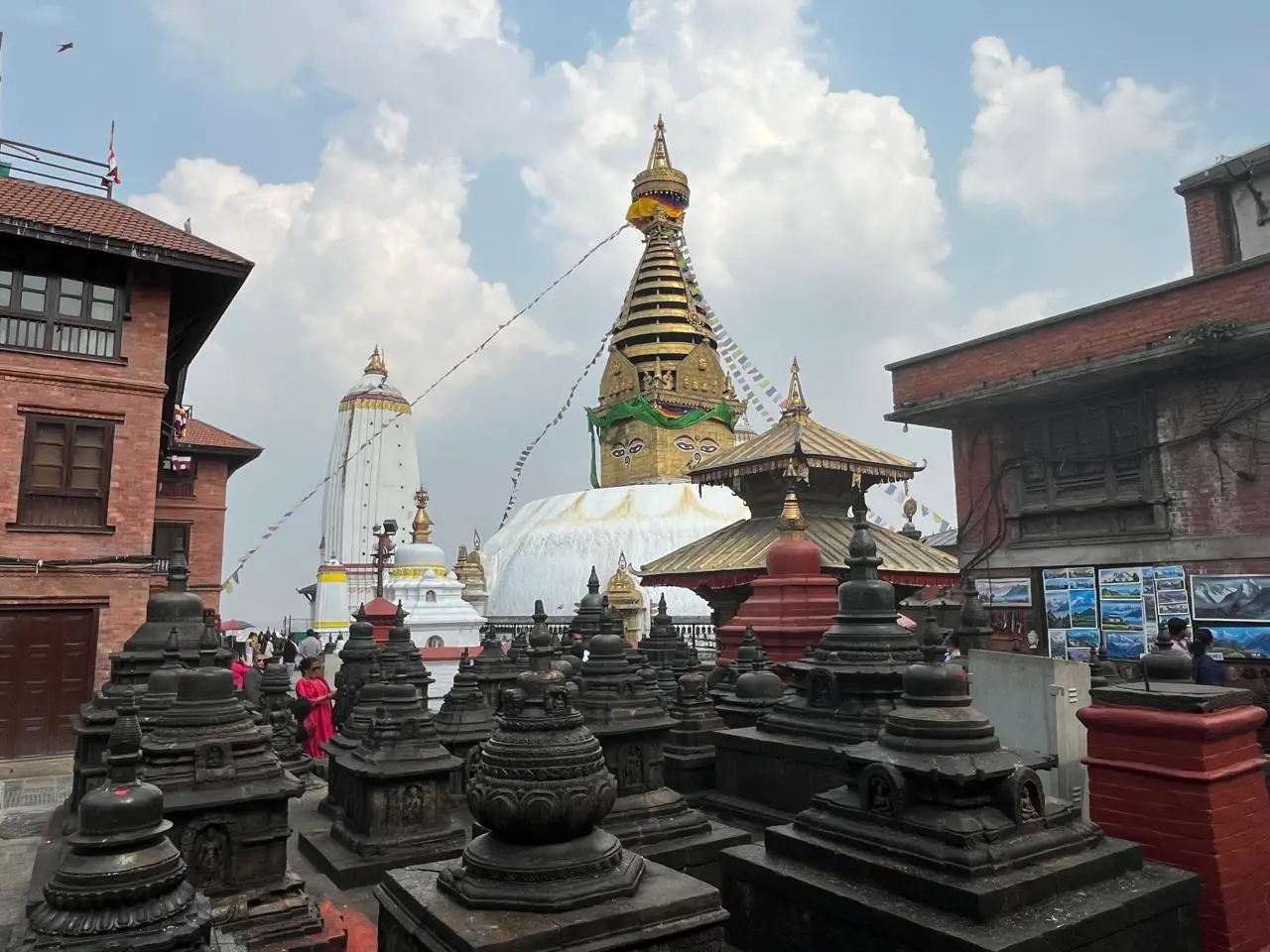
Swayambhunath stands on a hill west of central Kathmandu. The complex brings Buddhist and Hindu traditions into the same sacred landscape. Steps and sloping paths lead toward the main stupa, and the upper area provides a wide view across the valley when conditions are clear.
Patan Durbar Square is the third major stop of the day. Patan, also called Lalitpur, is especially known for its metalwork, carved architecture and compact temple courtyards. The square remains closely connected to the surrounding residential and artisan neighbourhoods.
The second sightseeing day covers four additional monument zones. Pashupatinath is an active Hindu temple complex beside the Bagmati River. Non-Hindus cannot enter the main temple, but they can observe parts of the complex from permitted public areas. Visitors should behave respectfully because worship and cremation ceremonies may be taking place.
Boudhanath is centred on a large Buddhist stupa surrounded by monasteries, homes, shops and rooftop cafés. Pilgrims normally walk clockwise around the stupa. Bhaktapur Durbar Square provides a quieter historic setting with palace courtyards, brick streets and traditional architecture. The day ends at Changu Narayan, an ancient hilltop temple complex east of Bhaktapur.
The official UNESCO Kathmandu Valley listing provides further information about the seven monument zones.
Chitwan National Park and Tharu Culture
After Kathmandu, the tour travels by road to Chitwan. The landscape gradually changes from urban valley settlements and middle hills to the warmer plains of the Terai.
Chitwan National Park was established in 1973 as Nepal’s first national park and was inscribed on the World Heritage List in 1984. Its riverine forests, sal forest and grasslands provide habitat for wildlife including the greater one-horned rhinoceros, gharial crocodile and Bengal tiger. Sightings depend on season, weather, animal movement and the activity selected; no particular species can be guaranteed.
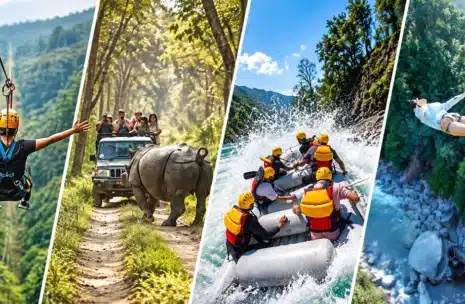
The itinerary allows one arrival afternoon and one full day for activities around the park. The planned program includes a canoe trip, guided nature walk, Tharu village visit, elephant breeding centre and an evening cultural performance. Activities may be rearranged according to river conditions, park rules and the resort’s operating schedule.
The Tharu community has lived in the Terai for generations. A village visit and cultural program provide some context for local building styles, farming traditions, music and dance. This should be presented as a respectful community experience rather than simply an evening show.
For the conservation background and current property information, travelers can consult the UNESCO Chitwan National Park profile.
Chitwan and Lumbini Tour Route
The Chitwan and Lumbini tour section continues west through the lowlands to Lumbini. This transfer is an important part of the journey, but road conditions and traffic can affect the duration.
Lumbini is a major Buddhist pilgrimage destination and an archaeological site rather than a conventional historic city tour. UNESCO recognizes it as the birthplace of Buddha, supported by the inscription on the Ashoka Pillar. The protected area contains archaeological remains associated with Buddhist pilgrimage dating back many centuries. UNESCO World Heritage Centre
The central visit is Maya Devi Temple and the Sacred Garden. Nearby landmarks include the Ashoka Pillar and archaeological remains around the temple. The wider Lumbini development area contains monasteries built by Buddhist communities from different countries, each reflecting distinct architectural traditions.
The itinerary also lists the World Peace Pagoda. Because the Lumbini complex is spread across a large area, the exact number of monasteries and sites visited will depend on available time before the long return drive to Kathmandu.
Travelers can read the official UNESCO information about Lumbini before their visit. Those whose main interest is Buddhist history and sacred places may prefer the more focused Nepal Buddhist Pilgrimage Tour.
Pace and Suitability of This Nepal Cultural Heritage Tour
This Nepal cultural heritage tour is graded easy because it does not involve trekking or high-altitude travel. Easy, however, does not mean entirely effortless.
The Kathmandu sightseeing days may involve stairs, uneven stone paving, busy streets and several hours outside. Chitwan and Lumbini are warmer than Kathmandu, particularly before the monsoon. Days 4, 6 and 7 involve substantial road travel, with Day 7 expected to be the longest.
The itinerary is suitable for travelers who are comfortable moving between several destinations in nine days. Guests with limited mobility should discuss vehicle access, hotel facilities and walking requirements before booking. Some protected monuments are not fully accessible by wheelchair.
Why Choose Our Nepal World Heritage Tour?
A Focused 9 Day Nepal Heritage Tour
This 9 day Nepal heritage tour concentrates on three distinct heritage regions instead of adding unrelated destinations. Two full sightseeing days are reserved for the Kathmandu Valley monument zones, followed by a nature and culture program in Chitwan and a pilgrimage visit in Lumbini.
Other practical benefits include:
- Airport pickup and departure transfer in Kathmandu.
- Guided sightseeing at the main heritage areas listed in the itinerary.
- Road transport between Kathmandu, Chitwan and Lumbini.
- Hotel or resort accommodation according to the selected package.
- Entrance fees for the listed temples, monuments, museums and cultural program.
- Jungle activities arranged as part of the Chitwan program.
- A free day in Kathmandu for rest, shopping or an optional activity.
- The option to discuss private departures or itinerary adjustments before booking.